
Elden Ring: A Years Late Retrospective
Join me as I look back on my trip through the most fun – and most miserable – game I have played in numerous years. This write up is late, and there is no way I’m contributing anything to any form of discourse regarding the game, but I enjoy the idea of restarting my blog with a callback to its origins: cataloging video games.
(There will be spoilers for a nearly 5 year old game in here, if you somehow care)
A Dark Soul
I expect many reading this are familiar with how I play video games, but I’ll go over them briefly here. I play games once, I beat it before purchasing and beginning another me, I play it on hard (if possible), and I don’t use any guides or spoilers or outside resources if I can escape them at all. These each have origins in my gaming history, and have helped curtail some undesired tendencies from the past. Keep these rules in mind while reading, because it plays a huge part in my experience here, as often does.
I love FromSoft games. I beat the original Dark Souls game before I decided to begin blogging, but Dark Souls II and Dark Souls III were both catalogued during the life of this blog – with some very early writing styles and little editing. Today, I think they are painful to read, but they tickled my nostalgia a bit even so. Each playstyle I chose during the trilogy contained a single through line – a connecting bit of style that separated me from many souls players – which was that I chose to use a shield. Early on, I decided that I would simply block most attacks instead of learning the mechanics of the game. Contemplating when to parry, or riposte, and sometimes dodge, felt to much of an ask for my simple lizard brain. During Dark Souls I used a heavy shield, heavy armor and a holy mace. It was very reminiscent of a D&D cleric, a character that outlasted and out-healed their enemies before bludgeoning them to death. In Dark Souls II I opted for a medium-weight shield in combination with a spear. I kept my enemies at a distance, blocking while regrouping and covering ranged attacks. For Dark Souls III I paired a dagger with a buckler, blocking when needed, but often relying on strafing to get in unblocked attacks in order to trigger bleed damage, substantially reducing their HP bar.
Which is all preface to say that, when building my character in Elden Ring, I decided I finally needed to forgo the shield entirely! I chose that no matter what, come hell or high water, I was going to approach the game in a way that forced me to learn any mechanic other than holding the block button until the enemy was vulnerable. I felt it was a culmination of my journey – each version of the game my builds become more and more vulnerable, focusing in greater amounts on avoiding attacks, rather than simply taking them to the face.
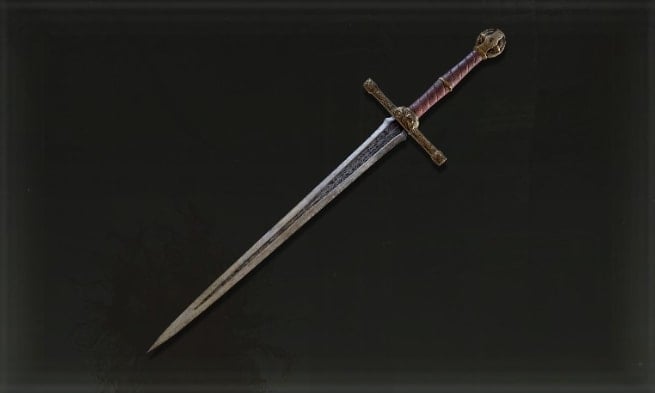
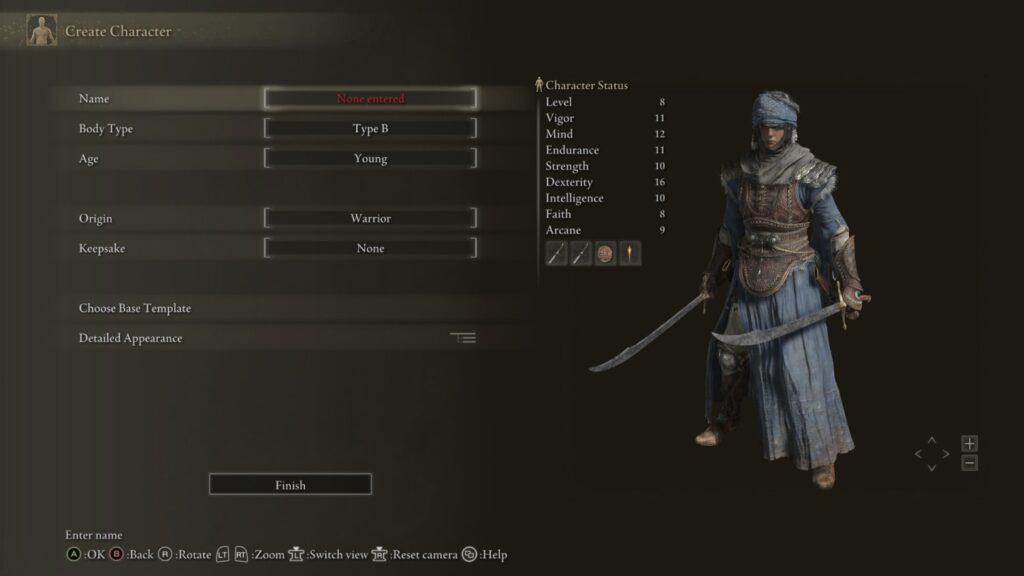
I Entered the character builder for Elden Ring knowing I was not equipping a shield in this play-through – not even once. Having already played cleric type – which I used as justification for not casting healing spells , and knowing I enjoy melee-based builds, I was left with two build options: one huge 2-handed weapon, or a pair of weapons. Being extraordinarily bad at timing slow attacks it left me one real choice: dual wielding. I picked the class with two curved swords – the warrior – though I quickly abandoned the starting weapons, though they were fun, for the much more direct and, to my playstyle, enjoyable Lordsworn Straight Sword.
The Lands Between
Before I continue, let me drop a little spoiler in here: except for a short time during the start of the late game, I never swapped them out. The attacks were smooth, the attack chain was rewarding, and the stamina usage was reasonable enough to regularly get extra hits in and/or dodge attacks as needed afterwards. I was hooked early on and glad I decided to drop the shield. Introduction and background out of the way, Its time for my adventures in Elden Ring!
I am not a skilled gamer – a fact that I have embraced and been clear to repeatedly enumerate here – but I am durable, and I am patient. These traits, both positive and negative, become extremely apparent during the experience that follows.
My beginning, like all new players was a a dungeon with but a single monster – a grafted conglomerate of long dead zombies – which attacked much faster and did much more damage than I expected, and that sword-wielding spider killed me swiftly and without much fanfare. This sent me to the true start of the game: The Lands Between.

The Lands Between is the name for the region where all of Elden Ring takes place. I don’t know what they are between, or how people get here. Its just called that, to the best of my knowledge. Here, following my first death, is where I am resurrected to begin the game itself. And thus, 18 hours of frustrating, infuriating, nigh masochistic determination to continue the game started. Entering the open world, I ground into the enemies before me. I explored around, and everywhere seemed more powerful than I was. I died again and again, failing to make any sort of forward progress. Every location, every enemy, every boss was a brutal challenge. Everywhere I went, I was blocked. Defeated by my inability to grasp the games concepts that were being continuously shouted at me. Enemies were unpredictable. They waited to long before attacking, or attacked to quickly. They stood their ground when I assumed they would run, and the continued attacking when I was convinced they were finished. My Hit Points were to low to absorb their massively damaging attacks, and I was unable to time my own counter-assaults to be effective in any way. I was intensely demoralized. But, I was also determined to beat the game. I don’t start something I am not going to finish, so I pressed on. I continued.
I endured.
But the game had put in front of me a towering barrier. A boss that I hadn’t even attempted to defeat more than a few times. Margit, the Fel-Omen. He stood as a barrier between myself and the game I would love to play. He stood astride every path forward like a furious, magic wielding troll. His battle arena was even on a bridge! I couldn’t even make progress against his massive HP bar and substantial damage. It was crushing.
Through my rather plentiful complaining and frustration, I was encouraged by my friend to continue exploring, find and defeat what enemies I could fine, and I would gather enough power, items and levels to defeat Margit, when the time came. I listened, but it felt egregiously slow. I didn’t find any big bosses, just a few minor ones, and grinding out levels on the static mobs in the world went mind numbingly slow, but as I explored, I did gain a sense, a feeling, of growing power.
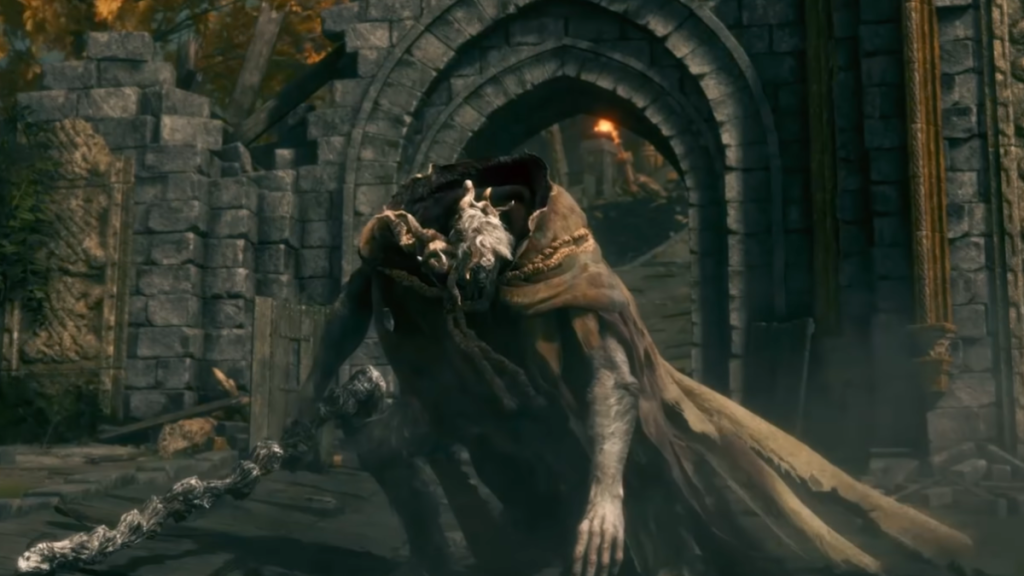
So as not to bury the lead any further: Margit was the second hardest boss in the game, and absolutely the most ball-busting required boss; and he is the first true boss in the game. You get to him extremely early, and he absolutely beats your ass when you do. And continues to do so over and over as you fight him, retreat, gain levels, and fight him once again.
Per my friend, I explored Limgrave, the Weeping Peninsula, and even made my way into Caelid – an absolute horror show of canid t-rex’s and crows the size of busses living in a crimson swamp that rots you from the inside out if so much as a toe touches its red waters – before deciding that there was no more power I could gain, and no more grinding I could tolerate. I had to simply buckle down, fight Margit, and defeat him. And I did. It took me 18 hours of game-play to before I moved past the first boss, and nearly a third of that was spent fighting him. All i needed was 800 hit points and 7 crimson tear charges, and I needed every ounce of both to advance. The exultation was intense.
Through the Wall
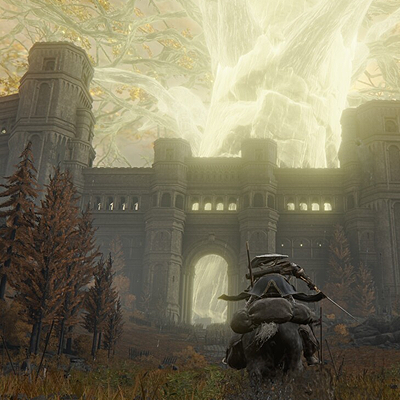
The absolute high that I received upon defeating Margit painted the entire next zone in rose colored glasses. Having been trapped in the lower wooded areas for so long, I spent hours poking around the castle that Margit had barred me from. Every corner was interesting. Around every corner were secrets and passageways and enemies. Even the tougher enemies were fun: Birds with swords and lions with swords and statues with swords. It was cool beyond any expectation. Dangers existed, but I was able to overcome and defeat them in a way that the game had gated beyond levels of grinding. A gameplay loop I strongly disliked. I was worried that the rest of the game would be more of the same, but I pressed on.
At this point, guided by an offhand comment from one friend to another, I retraced my steps and maybe take a better look around where I had come from. Merchants – I had only found one – had to be more common, right? Along the way I had also accumulated numerous crafting supplies, but the crafting menus was grayed out. If it was a part of the expected gameplay, it must be available early in the game, right? So, for the very first time, I went back to the starting area instead of trying to push forward. Here, where I first stepped into the Lands between, I discovered three very important things. First, there is a church I missed, with a merchant and a weapon upgrade station. I was beyond the need of the upgrades it could provide at this point, but it was neat. Second, This merchant whom is accessible from the very start of the game proper, sells the crafting kit. Third, this location provides me an interaction with an NPC that gives me the spirit bell, a vital item that can be used to summon allies who will fight alongside me at specific locations. It seems these would be important things to have access to. Twenty Two hours ago…
From here, my story will be less specific. With Margit beaten, the spirit bell, a crafting kit, and both weapons substantially upgraded, I carved my way deeper into the game. I did not have an easy time of it, but nothing caused me the same level of stress and frustration as the opening region. The guidance provided by the game – to get into Castle Stormveil and defeat Godrick – sounds absurdly simple, but is walled off behind in-game power to a level that drove me into absolute darkness. The bleakness I felt at the start of the game was all enveloping, drowning out so much of the enjoyment I could have felt from the game, but it was my decisions and skills that led me here so I have to own as of my own choices.
After Defeating Margit, though, I was freed from that weight. I was able to push farther in, explore, defeat enemies and – more to the point – overcome the bosses. The first test was Godrick the Grafted, and I avoided that fight for a while, concerned that I wouldn’t be able to handle fighting bosses at all if they were as challenging as Margit. To my great surprise, Godrick fell without much of a fuss. He was a fun boss that I learned, was able to adapt to, and defeat. It felt really, really good to be able to overcome another big fight so quickly.
As the game progressed and I encountered the absolute bevy of optional, field, and zone bosses, none of them approached the difficulty that Margit had been. While they were challenges, they were not obstacles that caused me great pause. In the course of the game, the most notable fights, in my experience, were the Godskin Apostle in the windmill village/under the Divine Tower Caelid, the Fire Giant, Maliketh, and Malenia. These fights tested my resolve, forced me to question my power level, and engaged my puzzle solving brain in a fun way. The rest of the named fights were fairly simple, puzzles that I solved without too much thought but still retained the elation when they were defeated.
In addition to the enjoyment of fighting the bosses, the zones were extremely cool to traverse in the open world thanks to Torrent, a spirit horse and my constant companion. While early on, the mounted attacks he provided were frustratingly more powerful than my standard attacks, as I upgraded my swords, and became more skilled this complaint faded.
Of the games zones, my favorite zone was, by an unbelievable margin, the capital city of Leyndell and its outskirts. The whole city was wild from top to bottom, with branching paths leading everywhere I could want to go. Its enemies were cool and didn’t use to many cheap or underhanded tactics, and the zone was so expansive and immersive that it actually felt like traversing a real city, an uncommon feeling in an RPG where you have to suspend disbelief to a great degree in order to believe its a city. I know that trying to render a real city in a game like this would be impossible – Grand Theft Auto has a hard enough time and its just a game based in a city – but it really felt like Leyndell was a ruined city long past its prime, now inhabited by both weird monsters and the husks of its past citizens.
Boss Business
When it comes to the bosses that I fought, my favorite has to be the Godskin Apostle. A simple, optional boss without an intense story, the fight itself was extremely fun, challenging, and just complex enough for me to need to adapt. It took me a significant amount of time to complete, but it never felt like I was just bouncing against a wall. I wasn’t struggling each time, hoping he wouldn’t perform a specific combo or do a specific move that would catch me in the middle of a no-win situation. Instead, each rep where I felt I could get better, learn and eventually and succeed. Additionally, he was the last boss I fought on my own. Following his death, I chose to utilize spirit summons – specifically Banished Knight Oleg – as often as possible, both because it was a part of the game that didn’t depend on being online (Something I’d done with all the previous Dark Souls games was beat them all without the boss specific summons or other players) and because I’d done the solo-defeat before. I didn’t feel the need to continue to struggle playing without them and develop a hatred of the game simply because I was being stubborn with this specific ability that the game had handed me. I was being stubborn enough in other ways, to be very honest. Besides. I never figured out the purpose of one of the consumables in my pouch, so I played the whole game down 5% of my hit points! Silly me, always accidentally taking the tougher route.
On the other end of the boss spectrum – those I became most frustrated with but still enjoyed – were Maliketh and Malenia. There are irritating for different reasons but landed together in the same bracket. I encountered Malenia first, so lets talk about her before moving on to Maliketh.
Malenia, Blade of Miquella
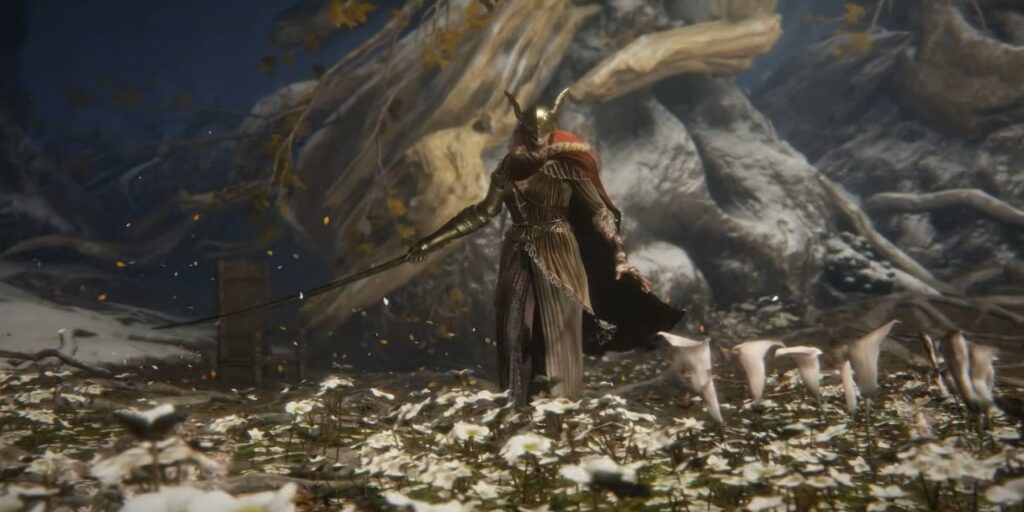
Malenia is a bullshit boss. Flat out. She angered me for nearly a week straight, and the only reason I was able to beat her was through a combination of massive luck and a wild change in my personal tactics. My second sword had been – for a little bit at least – a holy sword called the Golden Epitaph. It wasn’t really cutting it while fighting the godling, so I swapped back to my standard swords. Needing to counteract her healing, I enchanted one with bleed, and the other with frost. The quick buildup I got from the swift attacks, and the massive spike in damage that cause were extremely helpful in keeping her health low. This wasn’t my intended direction at first – I’d just wanted powerful swords – but it did the job. On the luck front, was the timing of her signature – and abusive – move, Waterfowl Dance. This frustrating move is something like 12 trillion continuous attacks in three separate phases that, even when dodged, felt like a death sentence. Combined with the healing it provided, it would tip the scales of the fight back in her favor every time. There were a few times I was able to roll well enough to skate by with a fraction of my health, but she would frequently pushing the advantage following the attack and skewer me. Furthermore, as this is a two-phase fight, in her second phase she has a similar attack but with the added effect of scarlet rot, which quickly builds up into a brutal damage-over-time effect (remember the swamp I bitched about earlier?) When I finally beat her, she only got off one Waterfowl Dance, which targeted Oleg instead of me, during phase 1, and then amazingly never left the ground in phase 2. Oleg and I Simply beat her ass as she stood there on the ground desperately trying to connect with an attack and being repeatedly disrupted.
I do not feel that I beat Malenia through skill and decision making, ability or experience. If I fought her a hundred more times, I would probably still beat her again only if the AI running her script chose not to perform its best move out of shame and pity. What an irritating design.
Maliketh, the Black Blade
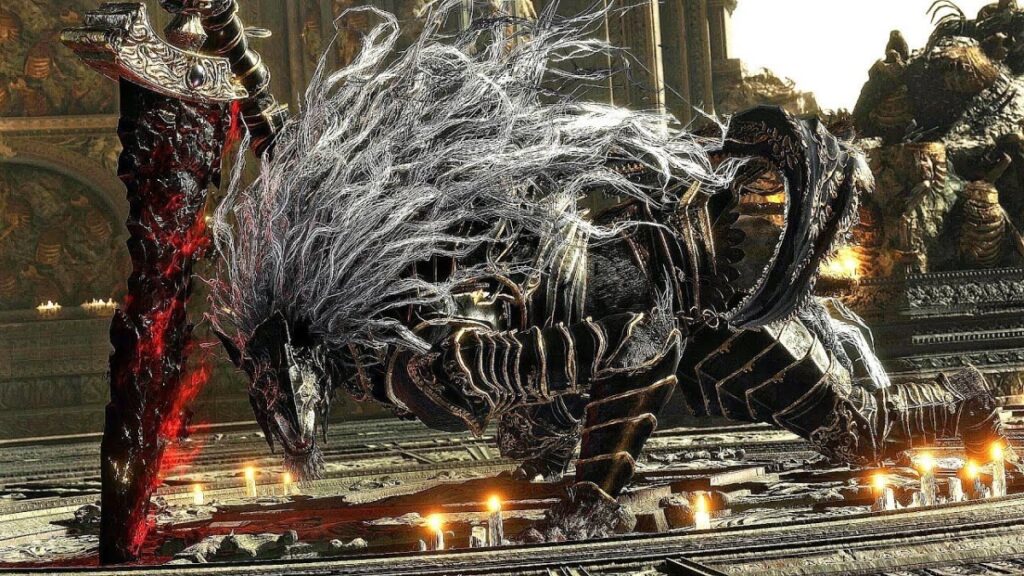
Maliketh is a bullshit boss in a completely different direction. Instead of being a challenge that feels like its stringing you along and ends up killing you after you made a half-dozen unavoidable errors, each a successive followon from a singular Ur-error in the fight, Maliketh simply removes your face as soon as you make the first error. I had even thought during the Malenia fight that it should just kill me instead of stringing me along, but as it turns out that was a dumb desire. Maliketh has a number of moves that, at least for my build, killed me flat out. It turns out I am not a fan of this concept at all. Thankfully, the first phase of this fight is miraculously simple and provides a glimpse of what is to come, it does not prepare you for the absolute – as my friend said to me – rowdiness of fight. He jumps into the air and hangs on pillars, he fires blasts of red-black energy that take up a third of the screen, and he actively reduces your total maximum health. He attacks fast, deals an wildly high amount of damage, and is hard to pin down as he bounces around the arena, both horizontally and vertically. In a great mercy, he keeps to the time-tested two-out-of-three design concept, where his damage and speed are high, but his durability is low. it took me a while, but once I was able to connect and see how much damage he took every hit, I could plan for when he was on the ground and play in his short, vulnerable windows. Additionally, I learned that creating space between myself and him seemed to cause him to perform his most brutal combo, so I stuck within roll distance as often as possible in an attempt to remain safe. Even when I was able to get one of the arena’s pillars between us I wasn’t truly safe, as when I hugged the pillar his attacks stretched through them just a bit and would hit and kill me. Even the terrain required breathing room in order for me to not simply die.
The fight against Maliketh felt like progression and learning, but it was in its most brutal and difficult form, learning learning a tidbit or two and then immediately being consigned to oblivion via the most over the top attacks. To be very fair to its design, the fight did not seem bad, unbalanced, wrong, it was simply just the most unforgiving destructive bullshit I’d encountered in the game. Eventually, through good timing and pressure to stay close, I was able to defeat him. Thankfully, it felt like a true success, and not a randomized victory like Melania.
The Lord of the Ring
With Maliketh out of the way, I was able to defeat the game fairly handily. Gideon was a pushover – I beat him to death in three outings, and Godfrey/Horah Loux was tough but in a way that I knew I could handle with skill, practice, and patience. So I did. I was surprised, however, with the final boss of the game. For reasons I don’t truly understand, Radagon and the Elden Beast aligned exactly with the methods that the game has shown me how to play, and I one-shot them both in an absolutely astounding feat for my dumb lizard brain. I enjoyed both fights and was satisfied with the conclusion – especially after the final bosses of all three previous games were merciless ball-busters. Having one that didn’t hold me up for hours and days and felt like a culmination of the games lessons, was immensely satisfying.
Once I beat the game, became the Elden lord, and lead the world into an age of Fracture, I realized that there were more demigods I could kill and get runes from. Freed from my previous constraits, I looked them up and realized that, having skipped the optional fight to finish the game with the desire to come back later, one of them was Malenia – I had absolutely botched my understanding of the game and had not realized she was one of the Demigods – and the other was Mogh, lord of blood. I won’t rehash Malenia’s story here. Mogh, on the other hand, I realized was located in zone that I had longed to explore, but never managed to figure out how to get to. After looking up how to get there I was happy to explore the area before reaching his area. His fight was not particularly difficult at the level I was, and I beat him to death in just a few reps, having learned to time my flask drinking to his weird death pulse. Very satisfying.

With all the demigods slain and the runes collected, I felt like I had done what I set out to do. The game has been beaten without once hefting a shield. I never became a defensive character, and I used two weapons the whole time. It felt good – 117 hours on – in a way that 18 hours played me couldn’t see yet knew existed.
As a final hilarious epilogue after beating the game, I looked up the endings so that I knew what could have been. This is something I do commonly as I only play the game once. I learned that one of the best possible endings I could get, and the one I thought I had actually achieved was the one for Snow Witch Ranni’s. I was surprised to learn that her ending was not the ending I received. I was convinced I had completed her storyline, and was curious what I had done wrong. What had I possibly missed that prevented me from getting the ending I wanted. It turns out I had missed an important bit.
During the final step of her questline, while exploring the cathedral and the plateau, I missed dropping into a pit. That pit – and that single pit alone – would have been the end of the quest line. I missed it by the barest of margins. I had come so close, and yet missed in the end. While some folks would consider that the very reason for guides and other resources, its the exact reason why I will not consult them. While some – I dare say many – people find it a foolhardy thing to fail a quest because you don’t understand what the game wants you to do, for me the story of my game, of my play through, of how I approached the puzzles and the game and the process are really vital. Missing something that wasn’t completely obvious is on me, and how I play the game. It created this tale I can share with friends and strangers alike, where we can share a chuckle and jaw about where we diverged and where we were similar. Stories like this don’t emerge in linear games. Its what makes open world, sandbox games so intriguing to me. Its all about sitting around the virtual camp fire and regaling one another with our lives in that shared world. Its what creates that connection, and what makes games matter to me.
Until next time,
Jonathon

