The Opus and the Glorious Purpose
For at least a decade I have had two projects working, tied to my two favorite hobbies, D&D and MTG. This week, I completed both. (Editors note – which is also an authors note. Due to me being bad at editing, this is coming out almost a month afterwards. These were accomplished the week of July 15, 2026)
Fantasy Forever
Fantasy wasn’t always my genre of choice. For the early-early years I read and consumed mostly mystery and adventure. I didn’t get into comics or movies or video games, and the what books I did consume were mystery or suspense or adventure. I can remember the dozens of Hardy Boys books I had when I was a kid. I even – shamefully – remember being bored while my teacher read aloud the entirety of The Hobbit during fourth grade. Which, looking back, is wild.
But when fantasy took hold, it never let go. I can accurately remember – whether its manufactured by my own mind or truly memories – my earliest interactions with both Magic: the Gathering, and Dungeons & Dragons. These moments became formative as I had just started reading fantasy books, and have gripped me ever sense. Together, the three hobbies etched fantasy into my soul. Is as vital to my existence as sleeping and breathing. Though there were times I have turned away for a little bit and flirted with other endeavors, I have always returned to the genre. There is something about imagining the absolutely impossible and contemplating its possibility that is truly magnetic.
For D&D, I was digging through the unfinished attic in our house in New York state, and discovered the AD&D Monster Manual among dozens of old books and tomes stored away in stale cardboard boxes. I instantly fell in love. While the numbers, stats, and abbreviations were incomprehensible to my my young self, I loved reading about so many cool monsters alongside their illustrations, habits, environments and group sizes. I was instantly hooked.

With Magic: The Gathering, the first cards I saw, bound up in a rubber band and passed to me surreptitiously in English class, weren’t good. But the art for them – Brassclaw Orcs and Raiding Party – is burned into my mind nevertheless. Those cards created an instant, indelible connection to D&D as another way to experience the same genre. The first cards I bought myself were a Revised (Third edition) Starter Deck, from which I pulled Fastbond, Basalt Monolith, and Sol Ring. I still have that Sol Ring, though it rests in a binder as part of my complete set of Revised. Encountering MTG so soon after discovering D&D really cemented fantasy as my favorite genre. (Sci-fi has taken hold in ways I never expected, but pure, gritty, sword and sorcery fantasy will always be my favorite).

Since middle school, these two hobbies have persisted, constants among the ever changing vagaries of life. Though I have taken breaks with MTG, D&D has only ever taken a back seat. They have both hooked me, together or in turn, no matter which other hobby had bubbled to the surface recently – enduring joys no matter what else was happening, and I was always trying something new with them. Whether it was writing an adventure or building a deck or creating new monsters, these were creative outlets that pushed me to larger and more complex goals, to find new and related hobbies, or simply to muse on the possibilities that they created.
The Magnum Opus
My original stint with MTG, which ended ~2002, culminated with an infamous deck among my playgroup: Black-Red land destruction. It didn’t have the best win rate, but it was a monster of a deck and was roundly disliked, almost as much as my friends counterspell deck. I loved it, though, and reveled in what I saw as “red control” that provided a path to push through my opponents defenses while ensuring that the were bound to limited resources. It was, if I am being honest, simply a bad red aggro deck. But it left an mark on my psyche none the less, giving me a love for land destruction regardless of its bad rap. Don’t worry though, I won’t defend it now – It is absolutely painful and can be a real drag on the game.
All that preamble is to contextualize my return to the game in 2012, and that when I began playing commander, I was dead set on making land destruction work. When it didn’t (I’m sorry Jonathan, for that pain I put you through!) and just made people salty, I turned my eyes from land destruction to using lands in novel and creative ways. Landfall – a mechanic which rewarded you for simply playing lands – felt too simple, and my brain whirred into action. I started by building a Green/Black deck based on sacrificing my own lands for vale. That deck didn’t prove effective, but it was a proof of concept that convinced me of a wild idea.
What if I could build 10 different decks that cared about lands without using landfall or land destruction, one for each color pair? What decks would those decks actually do, and how could they be built to match each colors supported functions? If I could solve this problem, it would be the coolest project in MTG I had ever done. It would be something I would remain proud of and tell stories about long after I stopped playing, if that ever happened.
The Giant Masterwork
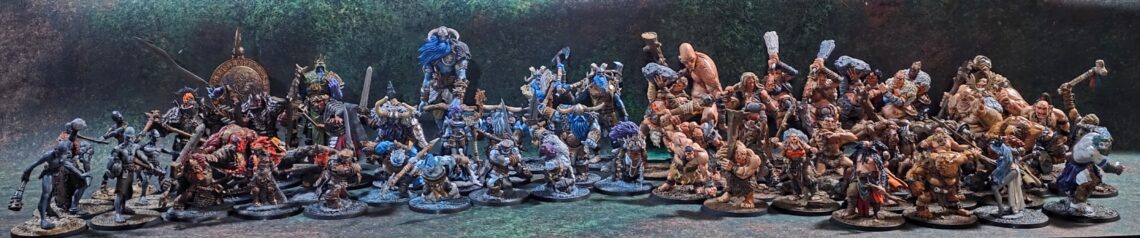
While giants are my favorite creature type now, I have not always been fascinated with them. Early on in D&D, I experimented with many different monster types, trying to find one that hooked me like other people seemed to be hooked by dragons or vampires. Demons, Elementals, Undead: None of them really grabbed my imagination. It wasn’t until I found the pewter Reaper giants in the early 2000’s that they really started to climb the ladder of cool monsters, and it was Bones Kickstarter I that truly solidified them as my favorite. I was Finally was able to grab half a dozen giants at a reasonable price to use in D&D. Picking up those models in 2012 began an epic collecting and painting journey that blossomed into a single goal: run Against the Giants using its original configuration with all painted giant miniatures. While I wasn’t focused at first, and these last few years I buckled down and made sure the giants I painted were relevant to the adventure. But how long was it going to take to complete it?
Decks of a Feather
Building and concepting the lands matter decks extremely challenging. While some color pairs were clearly defined, with commanders ready-built for their concepts, there were more than I expected which required creative thinking, digging through Scryfall, finding niche combos, and searching out Legendary creatures who could be built around. This was especially true for the two color pairs that have the least to do with lands: blue/red, and red/white. Both of these decks needed to be scrapped, re-conceived, and rebuilt completely. Its the main reason the project took nearly 6 additional months.
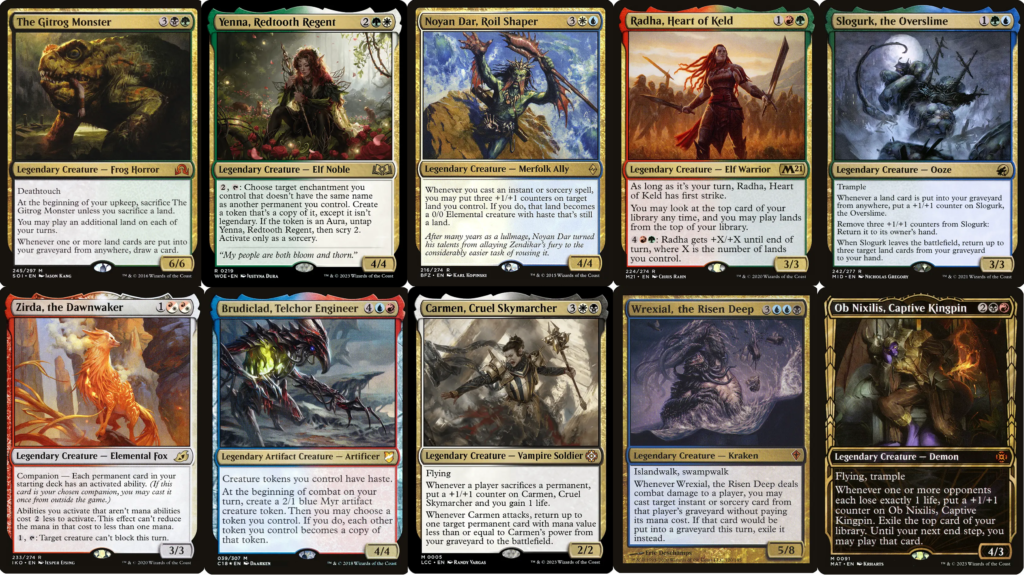
The first deck I built, the green/black one I took apart, was led by my absolute favorite legendary card: The Gitrog Monster. Using multiple land sacrifice outlets and return-to-battlefield options, I sought to gain value over my opponents and out attrition them with whichever method the deck presented to me. It didn’t end up working, but it allowed me to see beyond the typical combo-machine that the Gitrog is and one day, I’ll build my frog his proper deck.
Having to start somewhere else, green/red was an easy pick. Its a combination that likes lands, and has many cards that reference lands in many different ways. This deck was probably the easiest to build. Rhada, Coalition Warlord says on her card “equal to the number of lands you control” and that line of text is everywhere. Throwing copies of the best cards with that rule and calling it a day was all it took. The deck functions, does what the deck wants, and, surprisingly, isn’t that terribly common. A win on all accounts.
Amusingly, the blue/white deck was also an easy build. This color pair has so little to do with lands that, without a specific commander already built, it would probably have been one of the last. Thankfully, Noyan Dar, Roil Shaper is an older card that works with lands right in its rules text. Animating my lands, especially ones that are indestructible, and turning them into huge monsters by casting spells and proliferating is a fun concept. With the flexibility that the deck’s approach to lands has, it honestly doesn’t get old and has a lot of room for new cards to flesh it out in the future.
With those three decks in place (before tearing apart the green/black deck), I took a long break in both thinking about and building the decks while I wrote my D&D setting book. Every once in a while I would see a card that I would consider, and I started kept a list of strategies in my head for the un-built color pairs, a running tally of cards to look at in the future.
When Slogurk, The Overslime was released in Midnight Hung, the deck idea immediately flooded into me. Milling my own lands to make the Slime enormous and then using him to absolutely bludgeon my opponents to death is very out of flavor for blue/green, which felt correct for what I was doing with this project. I now had four completely different decks up and running! not quite halfway, but close!
While looking through cards for Slogurk, I stumbled across the concept for my black/blue deck, which unlike the previous two decks, felt very on-theme for the color pair but also wasn’t a common strategy. Both colors have cards that care if your opponents have specific lands in play, and with a little bit of work, I could build an entire deck around the concept. The best part of it all was that the Commander, Wrexial, the Risen Deep is the only card in the game who cares about both land types the deck was looking at.
For the green/white deck, it took a few different events all coalescing into a single idea that made the deck function. In a flash of insight, i realized that a deck idea I had been kicking around in more colors actually worked here. Both green and white have a number of enchantments that target lands. Combined with the value provided by doubling the enchantments using Yenna, Redtooth Regent as the commander, I was able to kluge together a deck that is surprisingly effective.
The black/white color pair was obvious. I knew that reanimator – that is, returning things from the graveyard into play – was a common theme between the cards, so I aimed for a lands-based reanimator deck. It started out sacrificing lands, but that didn’t end up working out. The sacrificing wasn’t producing anything of value. Then, some friends on the internet pointed out that the color pairing has a lot of ability that require discarding to get an effect, and discarding a land only to bring it back into play later can be extremely useful. Using Carmen, Cruel Skymarcher to lead the deck it can quickly spiral uut of hand with more mana than should be reasonable.
At this point, there were only three color pairs left, but they were the hardest to build. Blue/red, red/black and the red/white. I had a glimmer of hope for the red/black deck, but they were all going to be difficult. It took a lot of deliberating, but they were, more or less, sorted out at the same time.
The basic concept behind the blue/red deck was changing my lands into other land types in order to cheat the game system and make cards that wanted lands I couldn’t even put in the deck function. This deck – amazingly – was able to performed its duties exceptionally well, and the deck came together easily. However, winning with the deck, even just once, was absolutely out of the realm of possibility once I began playing it a few times. None of the cards that wanted multiple colors of mana was capable of winning, they were just tiny little value cards that helped the engine chug to nowhere. There wasn’t even a commander that helped the concept, and I went with Johan, Apprentice Sorcerer simply to get some value.
Red/black was a simple deck in theory but was hard to pin down in practice, and also the most irritating to play against. This worried me because I wanted to be able to not just build the decks, but also play with them, and win with them. The decks concept of causing the opponents own lands to damage them consistently over time painted a huge target on my face in but the few moments of the game. This deck was originally run by Tor Wauki the Younger, but eventually changes hands after a few attempts to Ob Nixilis, Captive Kingpin with great success.
The red/white deck gave me the most problems in every direction. Its a color pair that cares little for lands and doesn’t do much with them. It took a lot of musing, but when I stumbled across the combination of Zirda, the Dawnwaker and lands that animate themselves cost, well. I ran with it. I did manage to win a pair of games, but they both were won in the same way at the last moment, and required a specific infinite combo to succeed. It felt more linear than I wanted.
It was done! I had built all 10 decks! But, never happy enough to settle, I added another condition to the quest: I wanted to win one game with each. I wanted to prove to myself that the concepts worked, and they weren’t just me flailing about for 90 minutes while three other people looked on in shame. And I did it! Well. Kinda.
I won with every deck except the red/blue one. It was clear almost immediately that the color combination was nonfunctional, and would need, at the very least, to be rethought. And at this point in the Opus, I actually figured I could call that good enough and leave happy. I had made all the decks, and maybe one of them, though fun, just wasn’t going to be operational. I was done. It was good. I can move on.
But, of course no, that isn’t how this worked. Somehow, while minding my own business on the internet, I encountered a combo regarding cloning animated lands. Through some weird trick of the game, if a land was also a creature, if it was copied, the copy didn’t gain the creature statues, and only comes into play as a land. The light bulb went off in my head. Blue is good at cloning. If I could create a bunch of token lands, and turn them into creatures, that could be a slam dunk. Yes, the deck would scavenge many cards from the white/red deck and step all over its concept while it was at it, which would require me to rebuild that deck, but that was the cost of greatness. Finding Brudiclad, Telcore Engineer as the commander made the deck felt like it was going somewhere. Building and tuning came pretty easy, and the win quickly thereafter. It felt good. But, now I needed a new red/white deck
But first, I decided to take a detour and address the The Gitrog Monster deck. It had really been giving me grief. It took a lot of game actions and was doing things that were strange, but it never, truly, did what I wanted it to. At this point in the process, with the white/red deck scrapped and the project revitalized, I thought I would have some fun and build a completely new deck for the color pair. This one, led by Uurg, Spawn of Turg, was absurdly simple in concept. It wanted to get, and keep, as many lands in the graveyard. The execution, however, was brutal. It wasn’t because it was impossible, but because there were so many different ways to achieve the goal. It took a number of rebuilds, and more than two months of games, but the winning combination ended up being a deck that makes Uurg huge, and then throws him at your face for a win that really, truly shined.
While the number of iterations that blue/red and black/green had gone through gave me a bit of a pause, I had accidentally stumbled across the idea for the red/white deck as I was I pulling it apart. It would still be lead by Zirda, but would use her cost reduction in a different way. I would use red’s predilection for destroying my own lands for benefit and combine it with whites mechanic that helps you catch up on lands if you don’t have as many as your opponents do in order to cause mayhem. It worked well the first few times, but needed a win condition. After some thinking, enter the redirect spells. This would allow me to take damage that would be dealt to you or a creature you control, and deal it to some other target – hopefully an opponent. Through a number of weird card combinations, I was able to build a deck that deals damage to myself through land drops, sacrificing lands, and other bizarre angles, and turn it into a combo deck that can, if done correct, annihilate the opponents. It was clever and fun and felt like a white/red deck throughout.
With the red/blue deck able to win, and the revised concepts for the other two colors each with a game in the win column – the final one on coming on July 15th – I felt like my Magnum Opus was finally completed. 10 Decks, 10 different ways to win, 10 different color combinations. It was exactly as I wanted it. One day, hopefully soon, I’ll do articles around each deck its key cards and how to win, but that is for another time.
A Glorious Task
While I was working on all those decks, I was also preparing to run Against the Giants. While the Opus took a much longer time span to complete, the painting of giants took so much more actual time. If I had to guess, it would be hundreds and hundreds of hours bent over my desk with tiny paintbrushes and huge models. I will make no allusions: It was glorious. The entire time I felt like I was progressing because each model in its own right was a finished product. I won’t – as there are 53 of them – go through each one here (I’m sure I’ll do an article on ’em over time), but I will talk about the final stretch. At the start of 2025 there were 11 models left to paint. In ’24, I had only managed to paint around 8, but I wanted so deeply for this to be the last year, for the weight to be lifted from my shoulders. The stretch to 11 felt feasible to accomplish in single year if I put my mind to it.
To accomplish the task, I planned it out in thematic bites to help with painting continuity. I had 9 hill giants and 2 stone giants. I would paint the stone giants first and then three groups of three similar hill giants. The hill giants in set 1 were all similar to one another, being from the same manufacturer, and were unique sculpts. The second set were also similar to one another and from the same manufacturer, and much smaller. A chance to give myself a break, I hoped. The third set was identical to the first set. I hoped that I would be able to power through that final group and simply complete the task.
The stone giants went well, enough, but it became clear that leather was slowing me down. Any time it showed up in different places on a model, my pace ground to a halt as I differentiated each piece. brown is a very versatile color with many shades and tones, but it can get tedious. And the inevitable stitching was… tiresome. But I dug in, plowed through, and finished them both up in the first few months of the year.

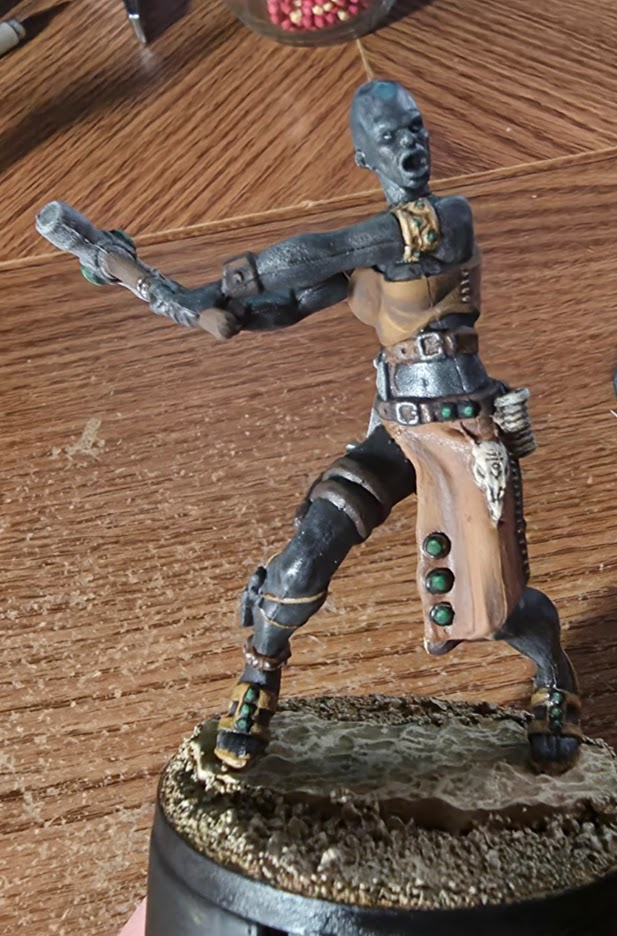
Once the stone giants were complete, I redid the math on what was needed for the adventure. I am always double checking myself. And this time I noticed that my original number (11) was wrong, and I actually needed another hill giant. Damnit. I found a simple reaper model and knocked him out in about two weeks. Simple and easy, with little leather, no complicated designs, and mostly skin. Having made the detour, I returned to the plan.
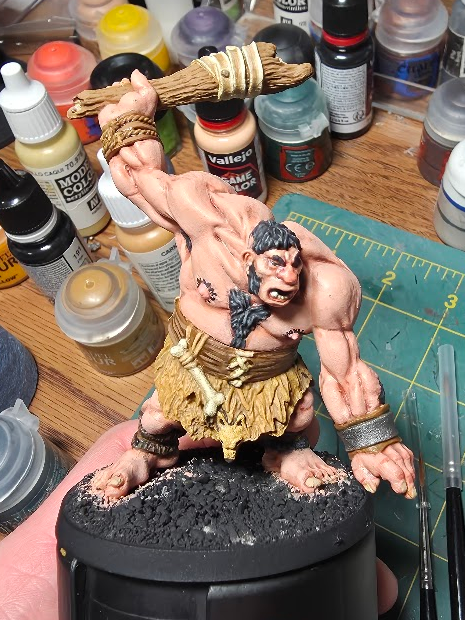
This first set of hill giants (and, therefore, the third also) were ones I had been looking forward to for a long time. It is hard to find female giants, let alone well sculpted ones, and having searched for so long to finally find them, I was excited to put paint to miniature. The group proved more challenging than I had hoped. Once again, it was leather. There was so much on these models. And so much rope! Each strand needed to be painstakingly painted as the detail wasn’t always there and needed to be added by me in certain places. These three took me significantly longer than I had hoped, which gave me a bit of dread for the third set. I finished painting those three mammoth models around the end of April.
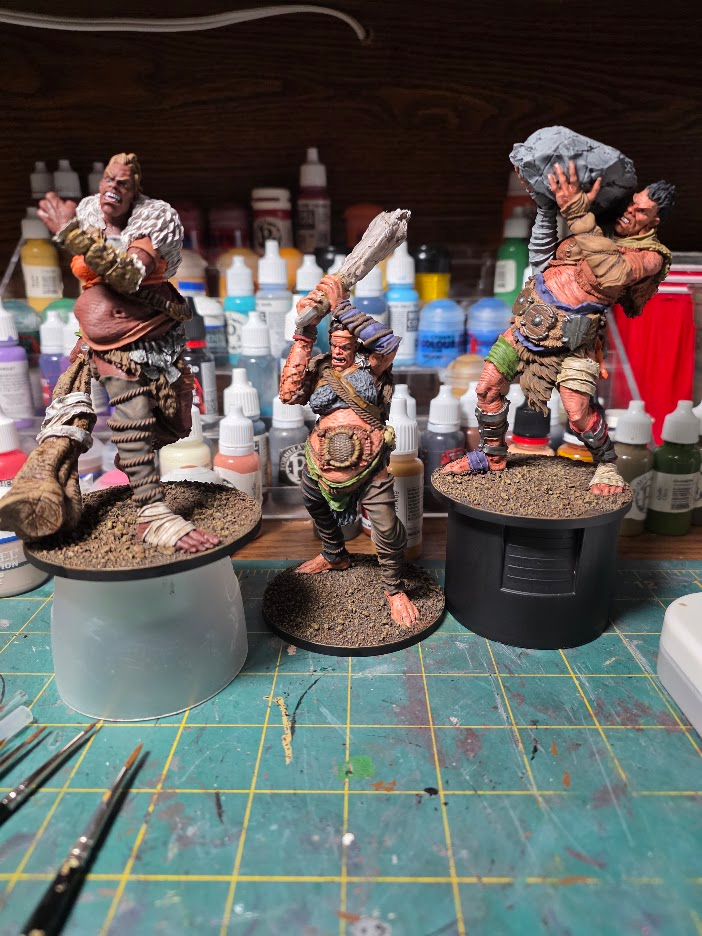
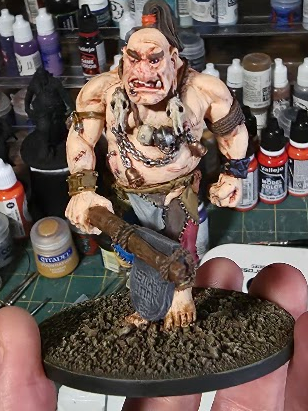
About the same time I finished these models, I also managed to snag a part that had been missing from one of my giants. A while back, I had been given most of an old, aspirational model from when I was much younger. Back then I couldn’t afford the expensive models, so I just had to look on with longing. Finding the missing part for sale on eBay in the UK at 1 in the morning was an absolute stroke of luck. This one jumped the line and was painted as soon as the hand came in. Though he had some details that felt a little tedious, he didn’t take long. It was a joy to paint, actually, and a testament to how good GW is at modeling, even back 20+ years ago. Even if I think many of the miniatures are overwrought, too busy, and over the top, they are still, simply, excellent models.
Following two seperate detours, its time to get back to the plan. The three little giants, which I had hoped to be a break in the process, proved… irritating. In ways that are hard to describe the quantity, amount, and variety of textures combined with how the miniatures layers had been sculpted made them difficult to paint. Not in a technical sense: the bones are bones, the cloth is cloth, etc. but in the physical sense that getting the paint brush and paint to specific areas was delicate and more frustrating than I would have liked. It took me some weeks, but by the second week of July, I had wrapped them up.
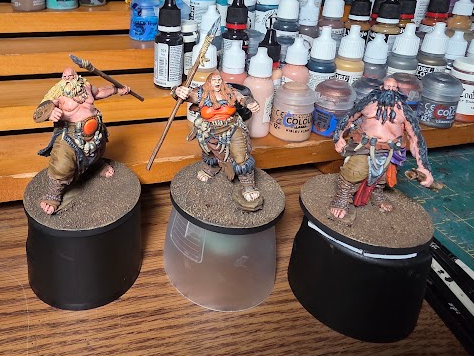
Following the difficulty of set one, I knew that now came the hard part. The final three with all their complicated leather and rope and all. With the addition of the GW model, I only technically needed to complete two of them, but the way I purchased them, I needed to paint all six of these female giants to make the bulk purchase worth it. Though the models were daunting, I had motivation to finish them. I could feel it in my bones. It was a pulsing desire to complete the task, to end what had been started so, so long ago. It burned to bright I began painting them the same day the small guys were completed. To be very, very clear: this is nearly unheard of for me. I often take a week or two break to settle out from finishing a thing before I start another. Let the brain drain off some of that tension.
But this, it was not a normal time. I was but a few models from completing a massive project. Both Saturday and Sunday I pounding away at the paint. By the time Monday rolled around, I was over 70% done due to an absolute flurry of activity and neglect to my bodies needs of water, food, and sleep.
And this is where the two projects collide in an absurd conjunction. As I was working on these last three models, I go as I do every Wednesday night to play Commander at my Local Game Bar. Having fiddled with it a week prior while avoiding the small giants, I brought with me the completed a version of the red/white deck. The green/black one had won a few weeks prior, and the blue/red before that. On the second game of the night, internally vibrating and excited, I won with an absurd lands combo, and calmly completed the Opus. On the way home, I mused about how cool it would be to wrap up both big projects in the same week. I resolved to do it.
Thursday and Friday proved to be difficult for painting, and I was a little stressed about the self-imposed nonsense goal. Saturday, however, was good to me. Over the course of the day I was able to finish first one, than two, and then the final model. I even finished their bases, took them off their paint stands, and posted the details online to make it real – once again, something I often do over the course of a few days. .

I had done it.
I had finished both the Magnum Opus and the Glorious Purpose within the same week.
Did it matter? No. It has no true effect on anything, or me. It is not the ending nor the beginning.
But it was an ending.

You May Also Like

Coldforged Preview: The Hegemony of Levisha

Coldforged: Izkoret and Halirath